Earlier this month, War on the Rocks published a two-part op-ed series authored by our own John Borrego, SVP of Aerospace and Defense at Machina Labs, that tackles one of the most pressing questions facing national security today: Is the way we manufacture defense hardware actually fit for the threats we face? Titled "The Additive Manufacturing Mirage in Defense” and “Hybrid Manufacturing: The Case for Agile Factories,” the series draws on decades of experience across defense, advanced manufacturing, and industrial innovation to challenge some of the prevailing assumptions shaping modernization efforts.
The timing could not be more urgent. As geopolitical tensions rise, supply chains strain, and advanced weapons systems evolve faster than acquisition timelines, the fragility of the defense industrial base is no longer an abstract concern. The two-part series makes the case that incremental fixes and isolated technologies are not enough. What is required is a fundamental rethink of how we design, build, and scale metal manufacturing for defense.
Just as critically, this fragility severs the feedback loop between the warfighter and the factory. When production systems are locked in by tooling, dies, and long qualification cycles, lessons learned in the field often arrive too late to matter. Design changes that could improve survivability, reliability, or mission effectiveness become cost-prohibitive, even when the operational need is clear. In a security environment defined by rapid iteration and contested domains, that disconnect is itself a strategic risk.
The Mirage of Modernization
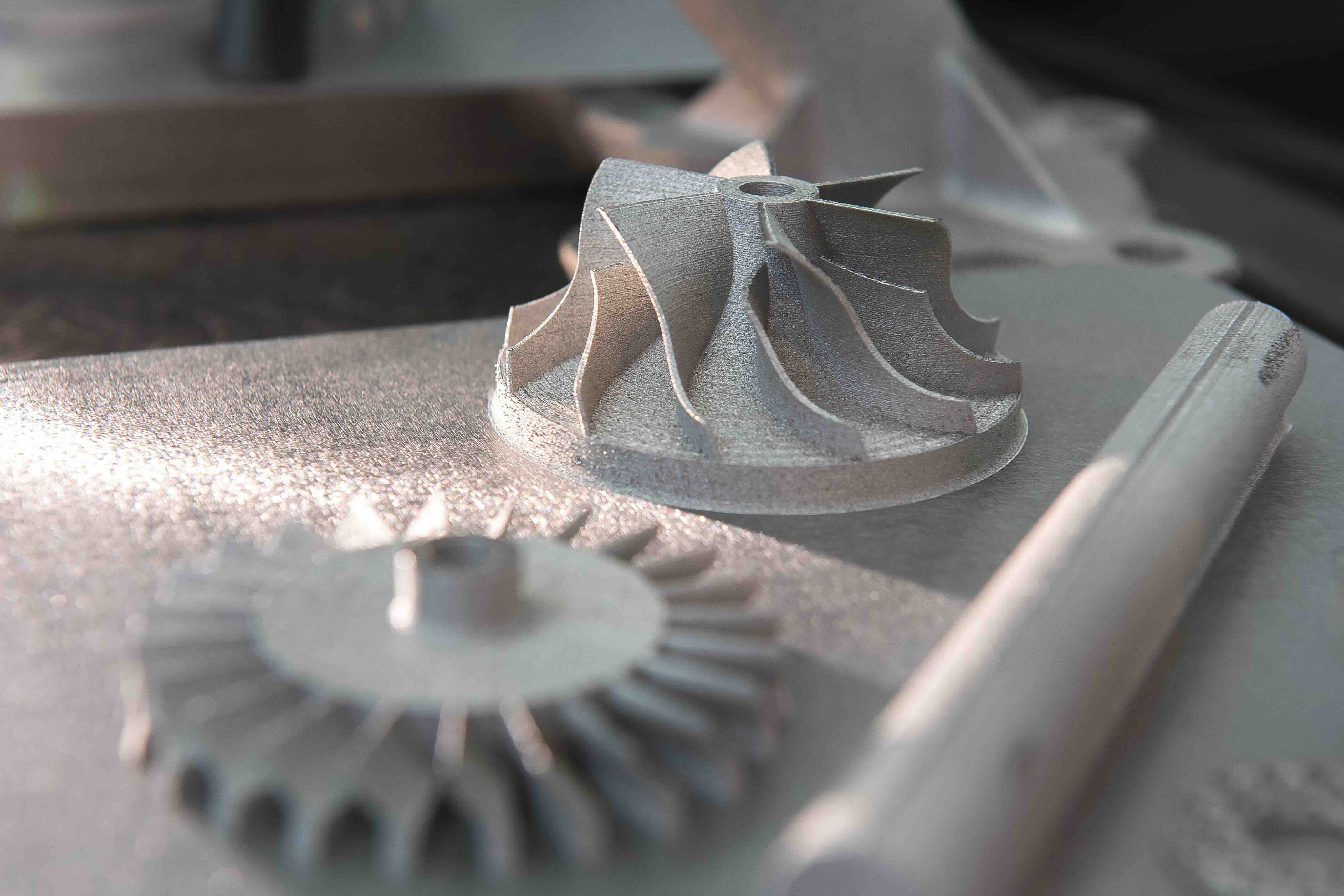 Army researchers study the performance of 3-D-printed metal parts and how they degrade as part of ongoing research in vehicle technology. (Photo Credit: U.S. Army)
The first essay, The Additive Manufacturing Mirage in Defense, takes aim at a hard truth many in the ecosystem quietly acknowledge: additive manufacturing alone has not delivered the industrial resilience it promised. While 3D printing has proven valuable for prototyping and some applications, it has struggled to scale for structural metal parts, demanding materials, and the production volumes required by defense programs.
The article argues that an overreliance on any single manufacturing modality creates new bottlenecks rather than eliminating old ones. Traditional defense manufacturing, still rooted in rigid tooling, long lead times, and centralized facilities, remains fragile in the face of disruption. As John notes, a system optimized for efficiency in peacetime becomes brittle under stress. In an era defined by rapid iteration, contested supply chains, and evolving threats, brittleness is a liability.
This is not a critique of innovation, but a call for realism. Defense manufacturing must be judged not by novelty, but by its ability to deliver mission-critical metal structures at speed, with confidence, and at scale.
Why Speed Now Equals Deterrence
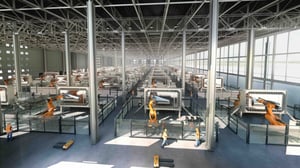
The second essay, Hybrid Manufacturing: The Case for Agile Factories, moves from diagnosis to prescription. It introduces the idea of the software-defined, reconfigurable factory as a cornerstone of modern defense manufacturing. Instead of betting on a single process, hybrid manufacturing integrates multiple methods into intelligent factory systems that can adapt as requirements change.
At the heart of the argument is a simple but powerful idea: defense manufacturing must move at the speed of threat. Hypersonic systems, unmanned platforms, and next-generation aircraft are evolving faster than traditional industrial models can support. Programs increasingly demand low-rate initial production, rapid sustainment, and continuous iteration. Fixed tooling and years-long requalification cycles are incompatible with that reality.
Agile factories, by contrast, are designed for change. They use software, AI, and robotics to reconfigure production without retooling entire facilities. They can be distributed, deployed closer to need, and scaled up or down without sacrificing quality. This approach aligns manufacturing with modern software development cycles rather than legacy industrial timelines, allowing factories to respond to real-world feedback rather than resist it.
Hybrid Manufacturing Is The Better Investment
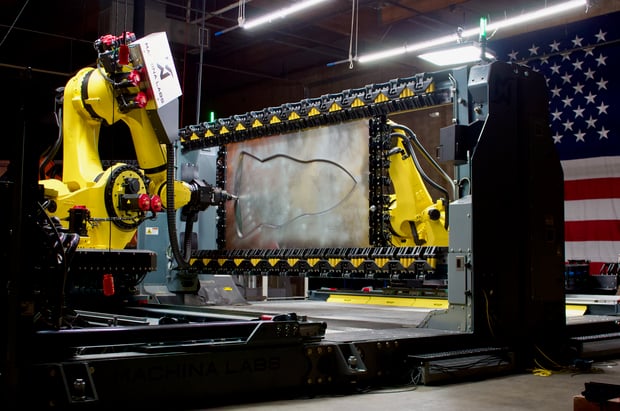 Machina Labs' RoboCraftsman forms the skin for a hypersonic demonstrator.
At Machina Labs, this vision is not theoretical. It is the foundation of how we build. The ideas laid out in the War on the Rocks series directly reflect the challenges we set out to solve with the RoboCraftsman platform and our agile, intelligent factory model.
RoboCraftsman was designed as a response to metal-forming processes that rely on dies, tooling, long setup times, and skilled labor that has been steadily declining. Using intelligent robotics and software, we form complex metal structures directly from digital designs, enabling CAD-to-metal workflows measured in days, not years. This capability is purpose-built for defense manufacturing environments where requirements shift, volumes vary, and timelines are unforgiving.
Our agile factory model extends that capability beyond a single machine. It enables distributed, scalable, and increasingly lights-out production across multiple sites. Just as importantly, it allows manufacturing to accept and act on bottom-up feedback from operators and maintainers in the field. Whether supporting hypersonics programs, airframe sustainment, or low-rate initial production of new defense systems, Machina Labs is building the kind of intelligent factory infrastructure the articles call for. It is a manufacturing design for resilience, not just efficiency.
In a broader sense, this is about Reindustrialization 2.0. Revitalizing the defense industrial base requires more than reshoring suppliers or adding capacity. It requires new production paradigms that treat flexibility, software, and intelligence as core industrial assets. Agile factories are not a future aspiration. They are a necessity for national security.
Read the Series: We encourage defense industry leaders, policy makers, engineers, and technologists to read both essays and engage with the ideas they present:
- Part 1: The Additive Manufacturing Mirage in Defense
- Part 2: Hybrid Manufacturing: The Case for Agile Factories
The future of defense manufacturing will be built by those willing to rethink the factory itself.