Capabilities
ROBOCRAFTSMAN POWERED ELASTIC FACTORIES
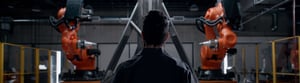
RoboCraftsman is Machina’s AI-driven manufacturing cell built to turn digital designs into production-grade metal parts fast. Each system integrates 7-axis robotics, autonomous sheet handling, and closed-loop AI controls, so process changes are code pushes, not rebuilds.
With on-the-fly tool and sensor changes, RoboCraftsman handles loading, forming, scanning, trimming, and drilling in a single workflow. Continuous software updates extend capabilities over time + enable new hardware capabilities like heat treatment, advanced path planning, and new materials.
PRECISION + SCALABILITY
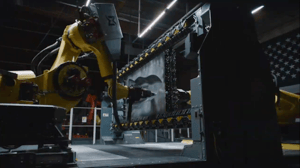
We pair a craftsman’s perception and dexterity with factory-grade repeatability. Real-time sensors and AI control forming and trimming to hold tight tolerances at any volume.
Every part carries its provenance: high-resolution process data is captured and stored as a digital twin, documenting steps, parameters, and inspections for qualification and traceability.

MATERIALS
We work with a wide range of metals used across aerospace, defense, and industrial applications. Our RoboForming process uses metal sheet stock up to 1/4" (6.35 mm) thick from multiple compositions, such as aluminum alloys, steels, titanium alloys, low-thermal expansion alloys, nickel-based superalloys, and refractory alloys.
We are working to qualify new materials based on program needs and are expanding support for high-temperature alloys, heat-treat grades, and specialty metals. If your product or program matches our capabilities, click below to connect with our team.
.jpg?width=300&name=Screenshot%202025-09-19%20at%209.58.02%20PM%201%20(2).jpg)
Frequently Asked Questions
RoboCraftsman™ is Machina’s proprietary AI-driven robotic manufacturing platform. Each cell consists of two industrial robotic arms, positioned on separate linear rails, with a frame to hold the sheet metal. One RoboCraftsman integrates multiple manufacturing operations ( metal forming, trimming, scanning, and heat treating), within a single, containerized robotic cell.
Using Machina’s RoboForming™ technology, the robots incrementally shape metal sheets into complex geometries — without the need for geometry-specific dies, molds, or presses. The same cell can manufacture different parts or structures by uploading a CAD file into our software.
RoboForming™ is a cold working process by which a sheet metal feedstock is incrementally formed into the desired geometry using AI and robotics for highly predictable, consistent results.
Today, RoboCraftsman™ enables the production of parts up to 12 ft (3.7 m) long and 5 ft (1.5 m) deep, and can shape structural sheet up to 1/4" (6.35 mm) thick with sub-millimeter precision.
- Aluminum Alloys (2xxx, 5xxx, 6xxx, 7xxx )
- Mild Steels (A1011)
- Stainless Steels* (304, 304L, 316, 316L)
- Nickel-Based Superalloys* (625, 718)
- Low Expansion Alloys* (Invar 36)
- Refractory Alloys* (Niobium C103, Haynes® 230)
- Other Specialty Alloys* (HyMu 80®, Magnesium, Brass, Bronze)
*Limited Testing indicates materials or conditions where we have completed initial trials, but additional R&D / funding may be required to achieve production-ready structures.
In its RoboFormed state, the larger of ±0.3% of the maximum dimension or ±1 mm (0.04").
Achievable surface finish is 125 µin (3.2 µm) Ra or lower.
Within the Machina’s elastic factory, post-processing (e.g., additional forming passes, trimming, heat treat, polishing, or finishing) can be applied as required based on product application requirements.
Yes. Machina accepts standard digital formats (STEP, IGES, STL) and can integrate into existing PLM or MES systems through secure APIs. Toolpaths are generated from CAD geometry, allowing engineers to move directly from digital design to a physical structure.
The RoboCraftsman enables the production of parts up to 12 ft (3.7 m) long and 5 ft (1.5 m) deep, and can shape structural sheet up to 1/4" (6.35 mm) thick with sub-millimeter precision.
Larger structures and assemblies are formed using multi-cell configurations and joining processes within our Elastic Factory.
Examples: ANVIL Truck, KC-135 Engine Mount, and Toroidal Tank for NASA.
If CAD data is well-prepared, forming can begin within hours of file receipt, with the first parts typically produced within one week.
Every application is different, and lead times vary based on design maturity, material type, inspection requirements, and production volume.
Airframes: Defense sustainment and replacement panels and skin sections for military aircraft.
Missile and hypersonic structures: high-temperature alloys and complex contours.
Mobility / Automotive / Boats: customized or lightweight body panels. Small metal boat hulls.
Emerging Applications: Expressive structures showcasing the intersection of engineering precision and creative design.We collaborate closely with customers during the early design cycle to perform applications engineering and DFM, optimizing part geometry, material selection, and forming strategy. This partnership minimizes risk, reduces cost, and ensures successful forming before production begins.
Machina’s Elastic Factory is a software-defined manufacturing facility composed of reconfigurable RoboCraftsman cells, and full integration and assembly production operations.
Unlike conventional tooling-based production, our Elastic Factories can rapidly reprogram for new designs, materials, or production volumes, enabling one-off prototypes, low-rate initial production, and full-rate manufacturing under the same roof.
Elastic Factories also support surge manufacturing and multi-program readiness, allowing multiple product lines to run concurrently within a single facility. Because all forming and process data are digital, the system provides long-term storage and preservation of institutional knowledge, enabling future replication and continuous improvement.
ISO containerized RoboCraftsman can be deployed to depots, test sites, or forward operating bases for true point-of-need manufacturing.
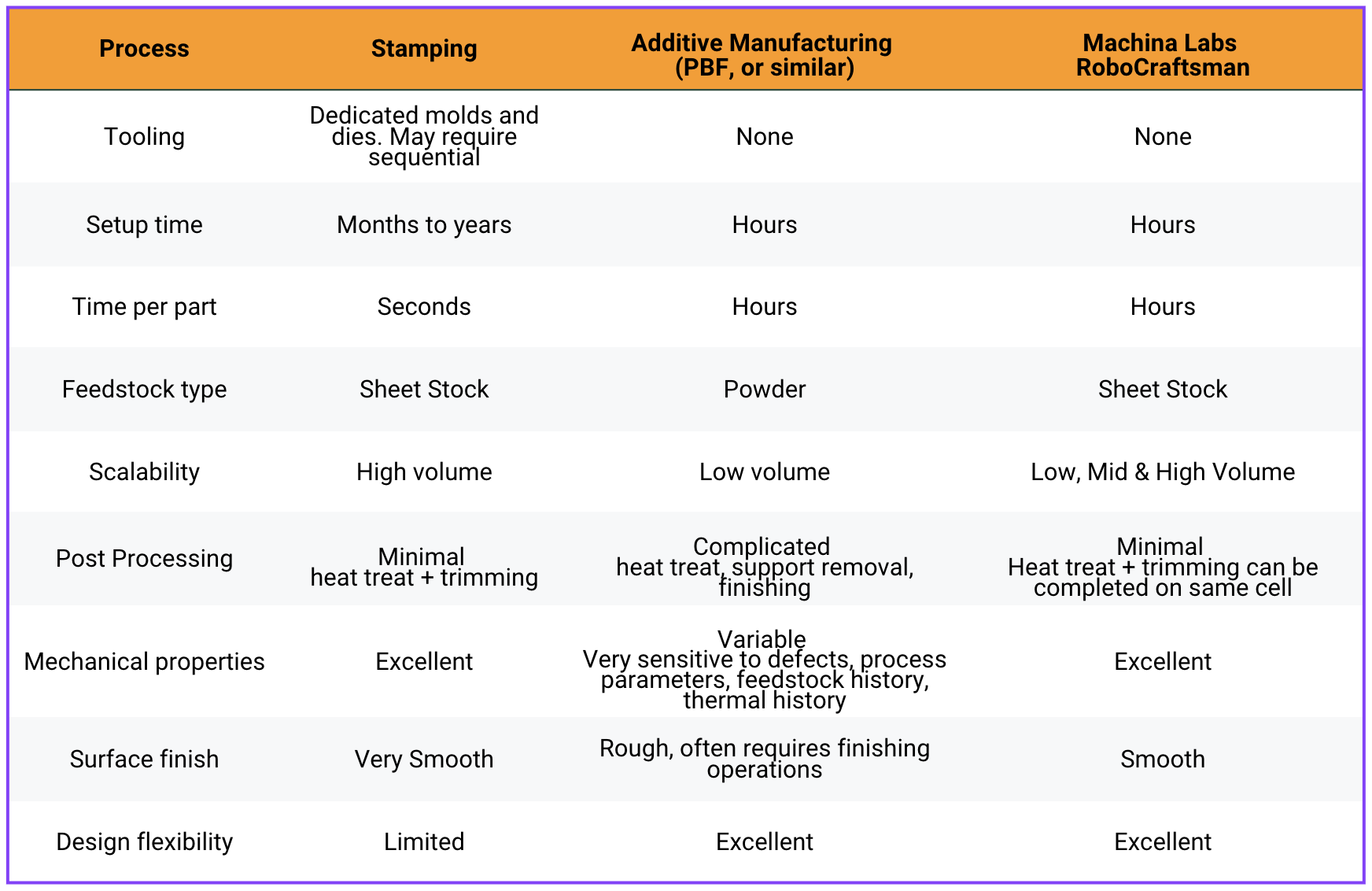
RoboForming bridges the gap by offering the speed and flexibility of additive with the strength and material integrity of wrought metal.
- ITAR Registered with DDTC
- CMMC Level 2 Certified (aligned with NIST SP 800-171)
A consolidated overview of Machina's current certifications and regulatory compliance is available as a downloadable PDF.