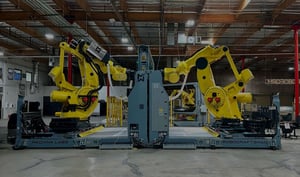
Integrating on-cell heat treatment to reduce distortion, simplify workflows, and accelerate production of complex metal structures.
At Machina Labs, (Robo)Forming is a core capability. Heat treatment is performed as a separate, off platform step. For metallurgical craftsmen and women, that gap matters. Metalworking has always been defined not only by how materials are shaped, but by how heat is used to manage a metal's internal state after deformation. When sheet metal is formed, whether through stamping, hydroforming, or RoboForming™, the material accumulates residual stress fields that remain locked into the part even after the forming forces are removed. These stresses are often invisible while the part remains fixtured, but they can later manifest as distortion or unwanted strain once boundary conditions change.
The most direct way to eliminate residual stress is heat: elevating temperature activates recovery mechanisms by increasing atomic mobility and allowing internal stresses to relax. For formed sheet components, the standard industry solution is furnace stress relief, where parts are racked, heated to a prescribed temperature for a defined soak time, and then cooled in a controlled manner.
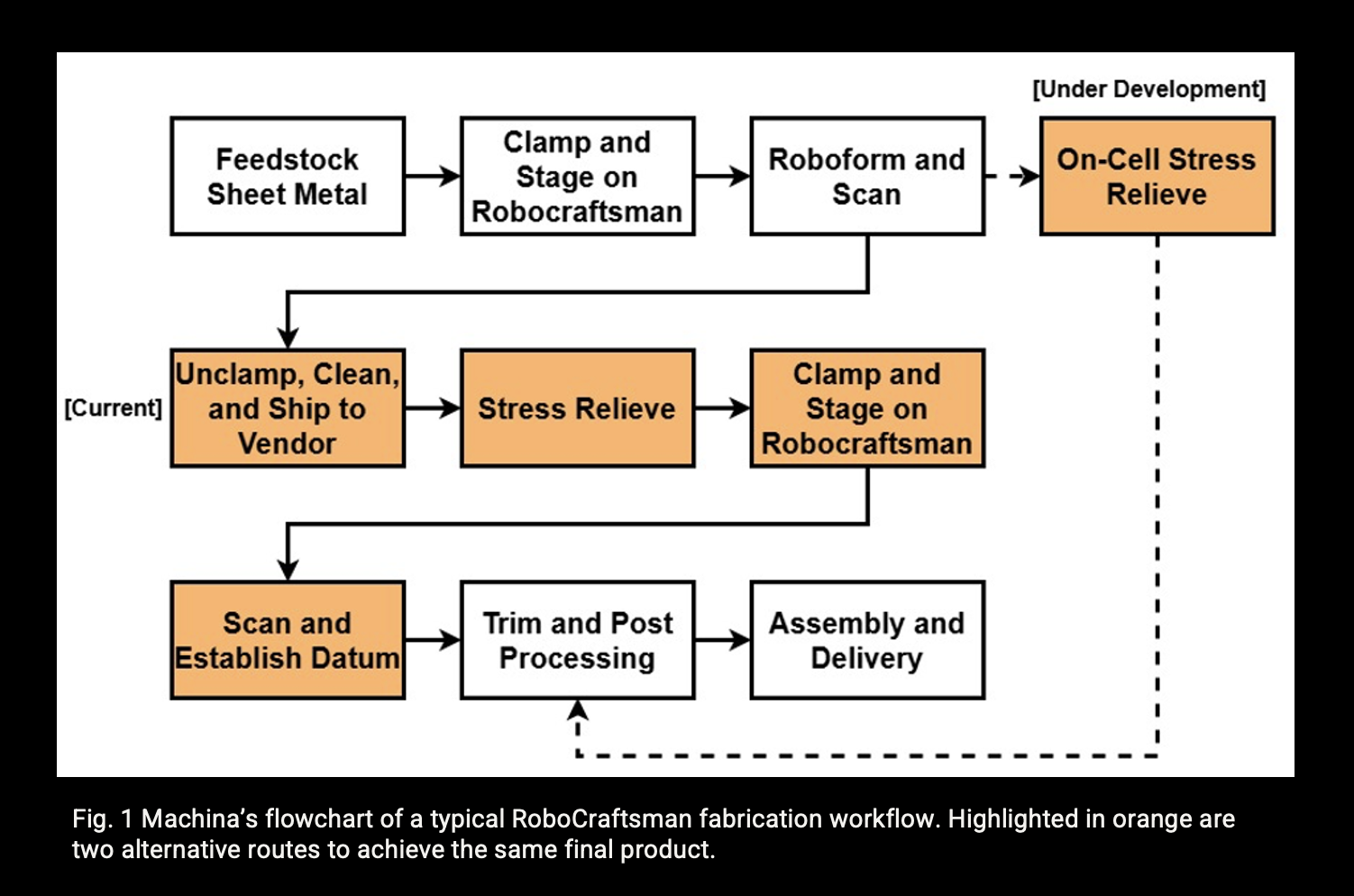
The challenge is not metallurgy: it’s process integration (see Fig. 1). Furnace stress relief is batch-oriented, datum-agnostic, and temporally decoupled from the forming operation. Parts must be fixtured, removed from the RoboCraftsman™, transported to a furnace, and later re-registered for downstream operations such as trimming. During transport and handling, untreated residual stresses can distort the part even with robust fixturing. This adds complexity, which introduces uncertainty and creates a bottleneck for scaling production.
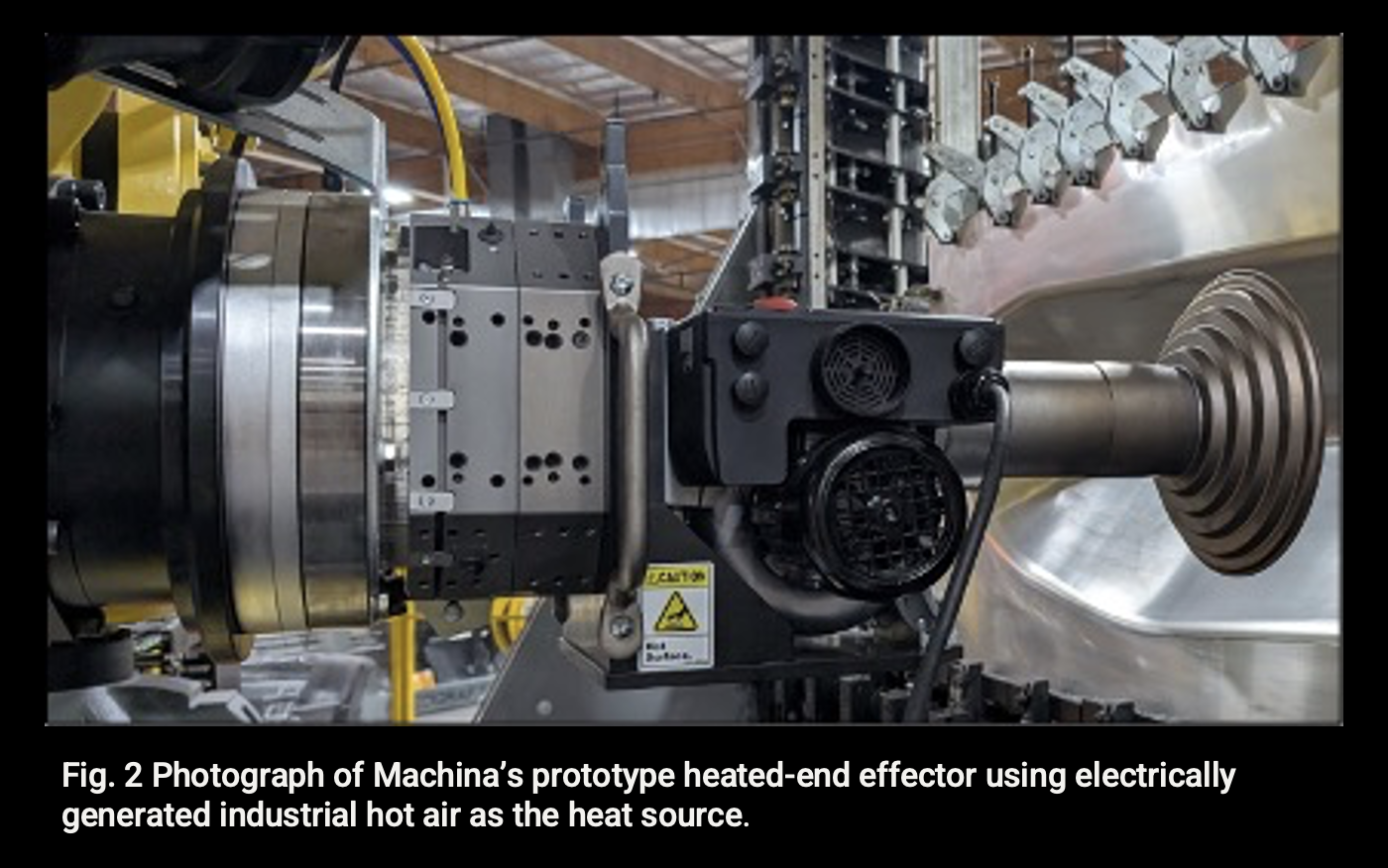
While addressing these effects with sophisticated fixtures or springback models, Machina is exploring an alternative approach: on-cell thermal stress relief. In this process, the part remains clamped on the RoboCraftsman after the final forming pass. The RoboCraftsman changes tools, swapping the forming end effector for a heated one, and traverses the surface with a controlled heat source. By integrating heat directly into the forming cell and monitoring it carefully, we can close the loop between forming, heat, and material behavior, bringing a missing pillar of craftsmanship back into the workflow.
Selecting a Heat Source
The majority of Machina’s work currently involves aluminum alloys, so we scoped the problem of on-cell stress relief around their thermal and metallurgical behavior. The end effector is the component at the tip of the robotic arm that interacts directly with the part. It must deliver controlled heat in a way that integrates with the cell's robotic motion system.
Candidate heat sources included induction coils, infrared lamps, resistive heaters, and laser-based systems. All are capable of delivering concentrated energy, but each carries tradeoffs in integration complexity, safety, or process control. After evaluating these alternatives, we chose to develop a system based on industrial hot air for its practical balance of safety, simplicity, and reliability, while still providing sufficient thermal power to bring aluminum sheets, ranging from 1–5 mm thickness, to stress-relief temperatures.
Hot air also provides distributed, controllable heating, reducing the risk of overheating localized regions while remaining straightforward to integrate with robotic motion. By coordinating robotic path with heater output, the system controls both temperature and dwell time across each region of the part. The result is a fully automated, on-cell stress relief process integrated into the existing RoboCraftsman ecosystem (Fig. 2).
Tracking the Heat
Applying heat is the easy part. The harder problem is knowing what temperatures the part actually reached, where, and for how long. Three approaches were evaluated:
Thermocouples provide precise, real-time measurements and are widely considered the reference standard for temperature sensing. In practice, attaching them to formed aluminum surfaces is difficult: adhesives and tapes can degrade at elevated temperatures, while spot welding or mechanical fixturing is more involved and can influence local readings. Each thermocouple also measures only a single point, making full-surface thermal characterization impractical. Thermocouples remain useful as calibration references, but not as a primary monitoring solution.
Temperature-indicating inks are applied to the part surface and change color or burn off when a specified threshold is reached. They provide a simple spatial map of areas that reached the target temperature and serve as a useful pass/fail check. However, they provide no temporal data and cannot indicate how long a region remained above the threshold. Each product also corresponds to only a single temperature point.
Infrared (IR) imaging is the most versatile option. Non-contact and real-time, IR provides detailed spatial maps of surface temperature as heat is applied, and captures how long each region remains above a threshold. This combination of spatial and temporal resolution gives engineers the insight needed to design a precise, repeatable process, ensuring effective stress relief without introducing new distortions.
Mastering IR Imaging
During Machina’s annual Hack Week, one of the teams demonstrated a proof of concept for IR imaging as a method for on-cell thermal monitoring.
The core calibration challenge: aluminum reflects over 95% of incident IR radiation, meaning an uncalibrated camera often captures ambient reflections rather than the part itself. To address this, the part surface must be coated with a material that adheres across the full temperature range and has a well-characterized emissivity. Graphite spray proved effective, providing consistent coverage with minimal interference with the heating process.
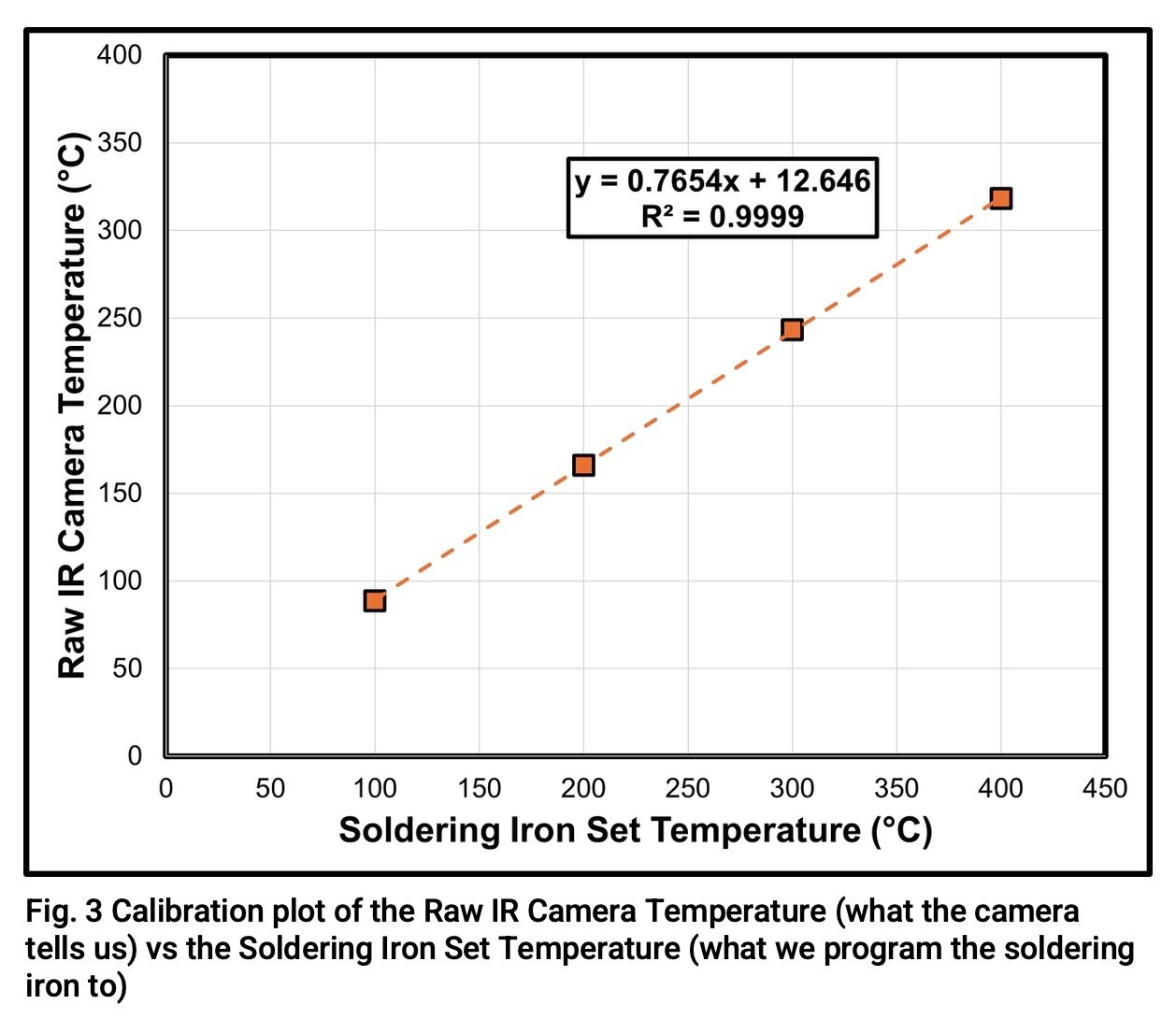
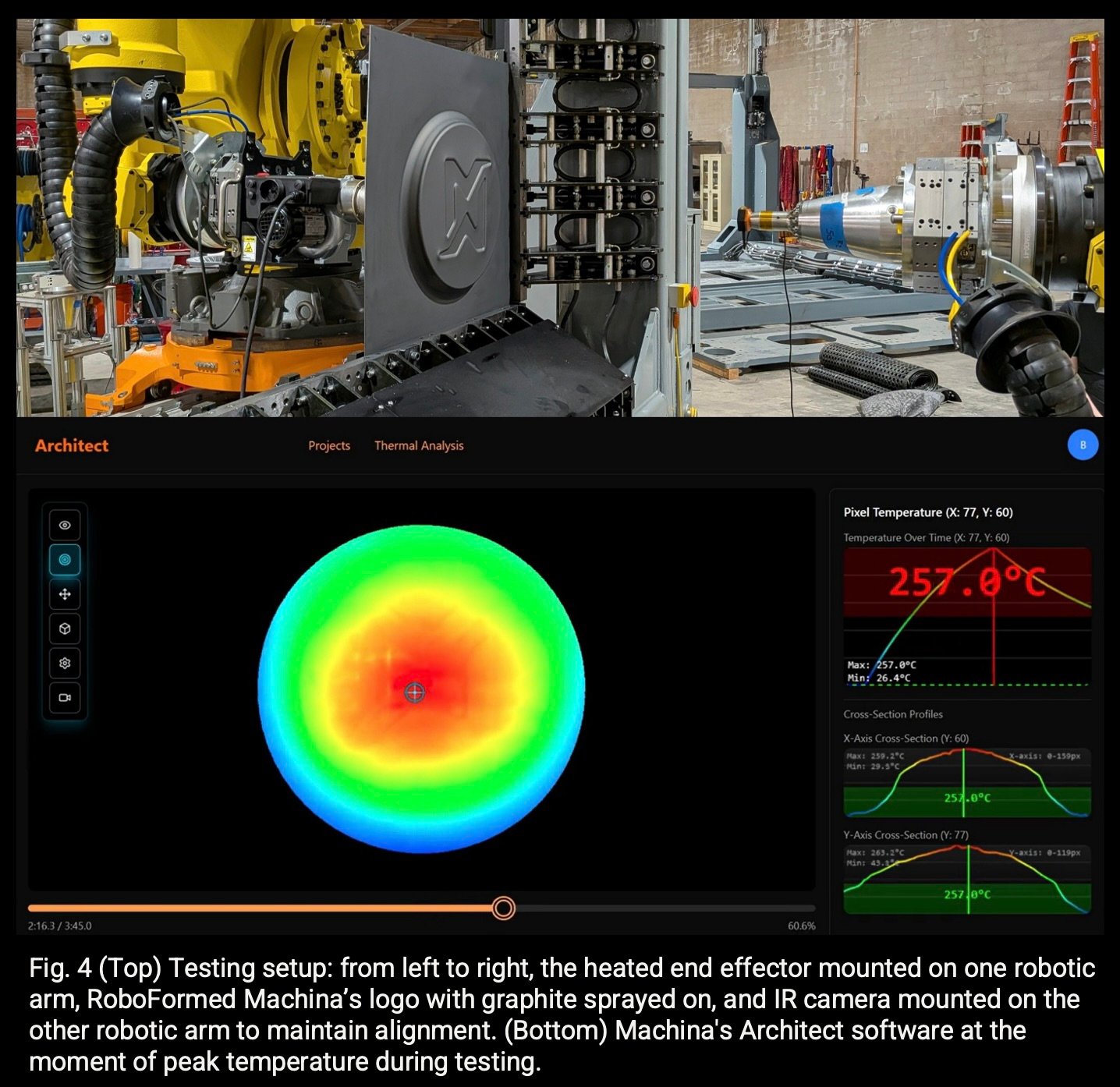
For imaging, we use a FLIR Lepton 3.5 camera to capture raw video, which is later post-processed for analysis. Calibration is performed using a digital soldering iron with the tip coated with the same graphite spray applied to the part. The soldering iron is heated to a range of known temperatures, imaged by the IR camera, and the emissivity is calculated by comparing the measured readings to the known thermal input. This ensures that the IR data accurately reflects the true temperature of the aluminum surface (Fig. 3).
The IR data pipeline extends beyond image capture: raw video data is ingested and projected into 3D space onto a mesh generated from a part scan, allowing temperature to be interpreted directly in the context of geometry rather than as a 2D image. Manual UV projection controls are currently included for alignment debugging, though these would be replaced by fixed calibration parameters in a production system. In parallel, the raw IR signals are converted into "real" temperature values using the established calibration, ensuring that each point on the surface corresponds to a physically meaningful temperature rather than just relative intensity (Fig. 4).
How We're Moving Forward
While the current system demonstrates strong capability, several challenges remain. Parts can and do move during heating, and this motion is not currently tracked by the IR system, introducing both data misalignment and potential collision risks. Additionally, single-camera coverage also limits visibility for complex geometries or high wall-angle features, resulting in incomplete thermal maps for highly three-dimensional parts.
On the process side, additional work is needed to optimize heating parameters, including speeds and feeds of the end effector, as well as overall robotic path planning strategies. This includes determining effective raster patterns and deciding how much of the surrounding "skirt" region should be included in heated path. The final benchmark will compare on-cell stress relief directly against conventional furnace processes to quantify differences in performance, consistency, and part quality.
Article Contributors:
-
Punnathat (Tent) Bordeenithikasem, Ph.D., Technical Projects Lead, Research and Development
-
Jim Selin, Head of Technology Development
-
Brian Gates, Senior Software Engineer
-
Chris Kutil, Technical Projects Lead, Defense Sustainment
-
Nathan Rudolph, Robotics Process Engineer, Automotive