A Class 3 UAV airframe demonstrator shows how parametric design and agile, software-defined manufacturing close the two bottlenecks slowing defense hardware development
Modern defense systems are not built against static requirements.
Missions change. Payloads change. Ranges change. Environments change. Hardware needs to keep pace. But the traditional path from requirements to production was built around fixed designs and sequential handoffs. When requirements shift, programs can lose weeks, months, or more.
At the Reindustrialize Summit, Machina and nTop are showing a subscale Class 3 UAV airframe demonstrator that previews a larger flight demonstrator now being prepared for testing with RCTestFlight.
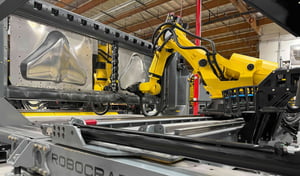
The flight demonstrator measures approximately six feet by four and a half feet and includes four formed metal panels. Machina completed the assembled structure two weeks after final design lock.
That timeline matters because it makes the promise of mission-adaptive development concrete: when requirements change, the workflow can absorb geometry updates without restarting a months-long tooling cycle.
Closing the Loop Between Design and Manufacturing
The geometry bottleneck comes first. Conventional CAD workflows are often built around one configuration at a time. Change a leading-edge sweep, update a skin thickness, or modify a structural feature, and models may require manual reconstruction before they are ready for simulation or manufacturing.
Teams compensate by locking geometry early, limiting the number of configurations they can evaluate before design freeze.
nTop’s role in this workflow is geometry. Its computational design platform enables engineers to encode structural requirements and manufacturing constraints directly into the model from the first iteration. When parameters change, the geometry regenerates automatically. The model remains simulation-ready and manufacturable without manual reconstruction.
Across this program, the teams evaluated 11 structural variants and ran 15 CFD cases before committing geometry to metal.
The production bottleneck follows. Traditional sheet metal fabrication often depends on custom dies, fixtures, and production planning built around a specific geometry. A design change after tooling begins can require new tooling, new fixtures, and a new manufacturing plan.
That makes broad configuration exploration expensive and slow.
Machina’s role in this workflow is production. Its factory manufactures metal structures directly from digital geometry using robotic forming, joining, and assembly, with no custom dies or dedicated tooling per geometry. When nTop’s parametric model updated, Machina could respond without starting a new tooling cycle.
For the flight demonstrator, Machina moved from final design lock to completed assembly in two weeks. In this workflow, a meaningful geometry update can reset the production schedule by roughly a week, rather than triggering a months-long tooling cycle.
Traditional sheet metal fabrication needs custom dies for every geometry. Tooling runs weeks to months, and one design change scraps it. We built a Class 3 UAV airframe with @MachinaLabs_ using zero hard tooling.@nTopology and @MachinaLabs_ are at @reindsummit in Detroit,… pic.twitter.com/8zOx842UEi
— nTop (@nTopology) June 15, 2026
Together, nTop and Machina connect requirements, geometry, simulation, and production in one loop. Design and manufacturing can iterate in parallel, not sequentially.
Why Sheet Metal, Why Now
For survivable, long-duration platforms, composites can remain the right material choice. But for attritable systems where unit cost, production tempo, and design variation matter most, the trade space changes.
The question is not which material is universally better. The question is which production model can deliver capable airframes fast enough, affordably enough, and in enough variants to match the mission.
For many attritable systems, metal airframes produced through software-defined manufacturing can create a different path: faster iteration, lower change cost, and a more flexible route from requirements to production.
From Mission Requirements to Real Metal
Parallel iteration is what mission-adaptive development requires.
Defense programs increasingly need families of systems that can adapt across mission profiles, payload requirements, operating environments, and production needs. The traditional model was not built for that pace. A workflow that compresses both the geometry bottleneck and the production bottleneck can support it.
“Defense systems cannot be built for only one fixed set of requirements anymore,” said Ed Mehr, CEO and co-founder of Machina. “Mission needs change too quickly. This demonstration shows how programmable design and software-defined manufacturing can work together so teams can move from new requirements to metal hardware without restarting the entire production process.”
“The gap between requirements and production-ready geometry is one of the biggest constraints in advanced hardware development,” said Brad Rothenberg, CEO of nTop. “Working with Machina, we showed how computational design and flexible production can close that loop, moving from top-level requirements to metal hardware in weeks, not months.”
A Repeatable Workflow, Not a One-Time Prototype
The UAV airframe demonstrator is a proof point for a repeatable manufacturing process, not a one-time build.
For defense companies, program offices, and emerging contractors, the value is a connected workflow that can support multiple variants over time without incurring the full tooling and timeline cost at each cycle.
That is the larger shift Machina is building toward: factories that are not locked to one part, one tool, or one production line, but can adapt as requirements change.
As advanced defense programs move faster, the manufacturing stack has to become programmable. Design systems, simulation tools, robotic production, and final assembly need to operate as part of the same loop.
This demonstration shows what that loop can look like. It also points toward Machina’s Edge Factory model: a portable, deployable factory that can bring production closer to the point of need. The same software-defined manufacturing model that enables rapid iteration inside Machina’s factory can support more distributed approaches to defense production over time.
Machina and nTop plan to continue developing the workflow through future defense applications and will publish a technical case study later this year.